By Steven Wandling
Read more: A24 DOES DEMONIC POSSESSION GEN Z STYLE IN NEW AUSTRALIAN HIT TALK TO METheatregoers rejoice! You no longer must be a slave to the false binary choice that Barbenheimer represents. There is a third option. Indie film powerhouse A24’s just-released Talk to Me is the horror counterprogramming audiences have been searching for. No costumes required, but certainly not discouraged, just a deep desire to be scared in the way that only inventive new cinema can provide. Talk To Me continues the studio’s streak of defying expectations of what an A24 horror film looks and feels like. The brainchild of Australian first-time feature filmmaker twin brothers Michael and Daniel Phillipou, known primarily for their popular Youtube channel RackaRacka, Talk to Me is bound to become the horror movie event of the summer, if not the year. Following its buzz-generating Sundance screening in January and a wide US and UK theatrical release last weekend, the brothers Phillipou can add instant horror sensations to their resumes with this wildly effective terrifying tale of 21st century demonic possession.
Over the past decade plus the studio has garnered the well-earned reputation as being on the forefront of a type of arthouse indie horror, slow burns full of unsettling vibes and heavier thematic material like Under the Skin (2013), The Witch (2015), and Hereditary (2018). As diverse as these films are amongst themselves, they all felt like part of a movement of extremely dark and meticulous films that became synonymous with the studio name. Change is good for everybody, even successful minimajor film studios, as last year’s double shot of grindhouse meets arthouse splatter fests X (2022) and Pearl (2022) proved. Writer-director Ti West (House of the Devil)’s shotgun blast of a double bill blew the doors off what audiences could expect. Coupled with the Gen Z slasher comedy Bodies, Bodies, Bodies (2022) and suddenly an A24 horror film could be fast-paced, naturalistic, youthful, and funny without losing any of the dramatic goods savvy fans had grown accustomed to expecting from the brand.

Sophie Wilde (The Portable Door) leads an ensemble cast of teens who, unlike many of the slashers of yesteryear, look, talk, and act like actual teenagers. The cast successfully brings to life the sort of kinetic untamed energy that can too often feel phony or forced in mainstream cinema across all genres, especially horror. Talk to Me allows the audience to be a fly on the wall of the sacred space that is a group of adolescent friends. The supernatural elements are balanced evenly with the dramatic as a social media driven rite of passage proves malevolent and terrifying with deadly and catastrophic results that threaten the lives of the protagonists and those close to them. Talk to Me pulls out an awesome feat of bringing classical supernatural elements like the group séance and the idea of demonic possession and thrusting them into the Gen Z vernacular without alienating the rest of the audience.
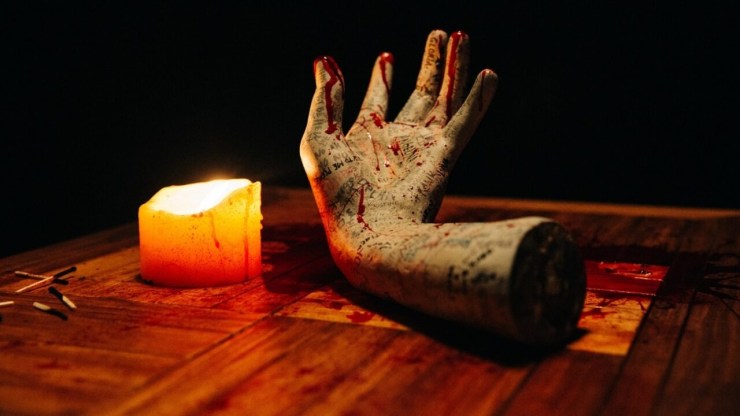
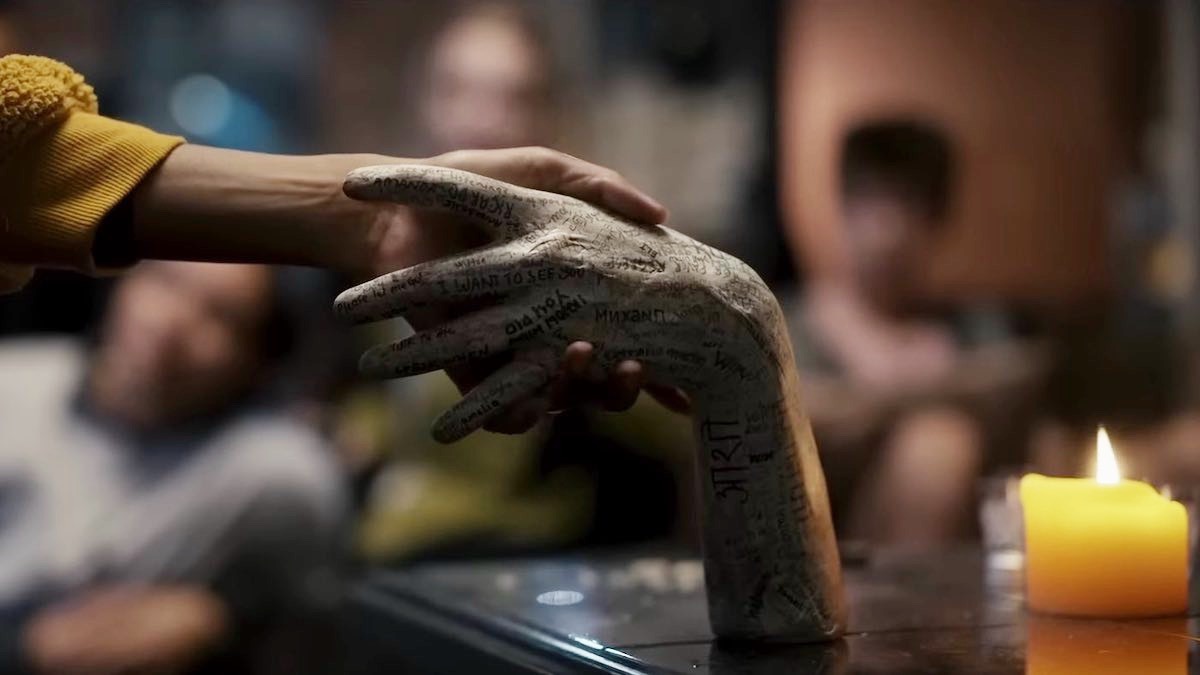
If every successful franchise begins with a great hook, then Talk to Me should bear much fruit for many years to come. A ceramic hand marked with occult symbols allows anyone who holds it and recants the words “talk to me” to see the dead, followed by reciting “I let you in” to be possessed by a spirit for 90 seconds. During the ritual, the person holding the hand is tied down to a chair while their friends observe and record the results with their phones. Like any good movie ritual, there are a couple of rules to follow that are simple yet disastrous for the partakers if not followed to the letter. Always light a candle to open the door to the supernatural when starting and don’t forget to blow it out to close the door back when finished. Most importantly, don’t let the dead possess someone for more than 90 seconds because the ghost “won’t want to leave.”
Before one can even think “but what could possibly go wrong?” things start to go dark and south quickly. The danger that is already inherent in teenage bonding goes into maximum overdrive and creates a palpable escalating tension that doesn’t relent for the entire runtime of the film. Talk to Me captures the sort of raucous, exuberant energy that feels exclusively adolescent in that it’s wild, unpredictable, thrilling, and often downright scary beyond comprehension. In the aftermath of her mother’s suicide, Mia (Sophie Wilde) spends most of her time avoiding her father Max (Marcus Johnson) essentially living and spending all her time with best friend Jade (Alexandra Jensen) at Jade’s mother Sue (Miranda Otto)’s home playing surrogate daughter and big sister to Riley (Joe Bird), Jade’s little brother. Jade and Riley’s father isn’t around so there is this collective sense of loss that bonds Mia to Jade, this absence of a parent that brings them together as their own family, and it’s this family unit that is very much tested throughout the course of the film. The dramatic elements and themes of the film become intertwined with the supernatural elements and the effective and surprising diverse jump scares, as if they’re two powerful forces of nature reflecting and magnifying the issues of non-communication and unchecked trauma that were already inherent in Mia and Riley’s lives.
Being a teenager is hard, especially in the post-Internet age of today. Reckless youth escaping their frustrated, traumatic existence with copious amounts of drugs and alcohol isn’t exactly a new thing, but the toxicity of social media is. Talk to Me shows how older supernatural entities that have existed in various forms throughout recorded history still very much thrive in the supposed modernity of our era. In that respect, the Phillipous have joined the conversation of J horror classics like Ringu (1998) and Kairu (2001). There is something inherently terrifying in this idea that society can progress as much as it likes on a technological level, but it can’t escape its own ghosts, or in this film’s case, ghost-masquerading demons. This dichotomy between the new and the ancient exists behind the scenes as well regarding Talk to Me’s use of practical effects over CGI.
Talk to Me is that perfect mix of a high concept film focusing on a small set of intimate well-written characters. The ending is a bit rushed in its execution, but the journey to get there is well worth praising. There’s a million different sequels, spinoffs, and prequel possibilities that in a decade audiences may pine for the days when Talk to Me was just an indie horror flick and not a behemoth studio horror franchise. Success is a wonderful problem to have though that should serve as a testament to the potential of the Phillipou Brothers’ future. There is wonderful craft in the writing and direction on display in the act of bringing the believable, nuanced characters and practical effects driven scares together. Talk to Me does not overexplain itself. There are hints and suggestions of demonic entities posing as ghosts, but it’s never explicitly named in the film. The Brothers Phillipou understand that these questions and more can be and should be left to explore in the sequel ahead.
Thanks so much for reading. Talk to Me is now playing worldwide only in theaters. Check it out and share this with your horror loving friends! Follow creepylovely on Facebook, Instagram, and Twitter. If you would like to write for us just shoot us a private message or DM on social media. Stay lovely! Stay creepy!



 CreepyLovely